Mostrando entradas con la etiqueta Carlos V. Mostrar todas las entradas

viernes, 15 de marzo de 2019


ECONOMY

The 16th century was characterized by a population growth in: Castile and in the southern regions (because of the trade with America). However, the Crown of Aragon didn’t increase too much the population.

Agriculture grew progressively as a result of the growth of the population and the demand of America. For this activity, the land (property of nobles and clerics) was limited and the prices of the leases very high. This led to many peasants to mortgaged their farms or borrowed money to lease the land and consequently cultivated in it. In the case that there was a bad harvest, the peasants could not pay, so they lost their land. These lands were given to the nobles and clergy.

There was an expansion of the craft industry thanks to the demand of the American market. It developed:
  • Basque metallurgy
  • Naval construction of Valencia and Catalonia
  • Advances in the textile guilds of Seville, Toledo, Cuenca and Segovia

Trade was the sector that developed most thanks to the exploitation of the New World. The commercial growth was centered in the Castilian cities and the ports of the Atlantic, while the Crown of Aragon and the Mediterranean ports fell by the Turkish presence.

DOMESTIC POLICY

The expulsion of Moriscos was ordered(on April 9, 1609):


  • They were accused of beign fake christians and of practising their own religion in secret.
  • Felipe III wished to demonstrate his commitment to Catholicism and compensate for ceding to the Protestants in Low Countries.
  • The expulsion had a negative effect on the Spanish economy(aproximate 300,000 of moriscos abandonated the Peninsula), particulary in agriculture.


CULTURE

During the reign of Carlos V, cultural development was related to an economic expansion, as well as a political and cultural conjuncture. In the 16th century, Spain was between a humanist spirit of the Renaissance and the orthodoxy of the Counter Reformation.

The most outstanding events were:

  1. The number of patrons, universities and printers grew. This led into an increase of university students and with that, Spain became a country of a high educational  level.
  2. The culture of the time was conditioned by the role played by Spain within Europe (change of mentality on overseas travel).


During the first part of the 16th century, an atmosphere of intellectual and religious tolerance was highlighted, while in the second half it became an advocate of Catholic orthodoxy coinciding with the Counter-Reformation.

The Spanish society was dominated by the aristocratic and religious values ​​that were based on a premise which led to a negative effect on the economy:  existed a pride of the old Christian and the hidalgo who, although was poor, despised manual labor, mercantile business and considered improper the spirit of profit.

Thanks to overseas trips, mathematics, astronomy and cartography were developed. In addition, contributed in geography, ethnography and the natural sciences. The heliocentric theory of Copernicus was one of the great novelties.


Spain had great developments in:
  • The mercantile calculation
  • Shipbuilding
  • Navegation


SOCIETY

It is a class society, based on privileges, rights and obligations, marked by birth. In society the following estates were distinguished:


Nobility (5%) ranged from the Titles of Castile and Grandes de España, a true élite that accumulated immense patrimonies, to knights or hidalgos with much more precarious haciendas. 
Also, throughout the XVI and XVII centuries were common purchase of titles and access to the nobility for services to the monarchy (nobility of toga).


             It was also remarkable the differences between the clergy(5-10%):
  •  The high clergy (archbishops, cardinals and abbots) maintained situations similar to the nobility.
  • The lower clergy (parish priests, chaplains, monks ...) lived, in general, similar to the artisans or peasants. 


Among the unprivileged

 The pecheros and farmers (urban population )subject to the payment of taxes and ordinary justice (80%). 
There were also many differences between them: the lives of the agrarian landowners or of the great merchants. 
However, all of them were obliged to pay taxes, which in Castile were very high and numerous.


lunes, 11 de marzo de 2019

FOREIGN POLICY

 Againist France:
 There are 3 reasons why there was this problem:
  • France its surrounded by spanish  territories.
  • Spain and France wanted to conquered Italy.
  • Carlos V and Francis wanted became the emperor.
Francis I made several wars againist the Spanish Emperor. In the firts one, Francis I  was defeated in the Battle of Pavia(1525), Carlos conquered the Duchy of Milan.
Francis I  made alliances to weaken the power of the empeor.


Againist the Ottoman Empire :
Sultan Suleiman the Magnificant began to expand his empire.
 In 1529, he attacked Vienna but the city resisted. 

The Ottoman Empire had converted the Berber states in northem African into vassals.
The Turk Barbarossa controllled the Western Mediterranean from Algiers.

Emperor troops conquered Tunisia in 1535 but failed to take Algiers in 1541.


Againist the German Protestant :
The emperor foufht the Protestant princes in the Schmalkaldic War(1546-1547) and defeated  them in Mulberg.
Resultado de imagen de carlos V en mühlberg

The hostilities resumed in 1552 and Carlos V signed the Peace of Augsburg in 1555.


martes, 5 de marzo de 2019


DOMESTIC POLICY
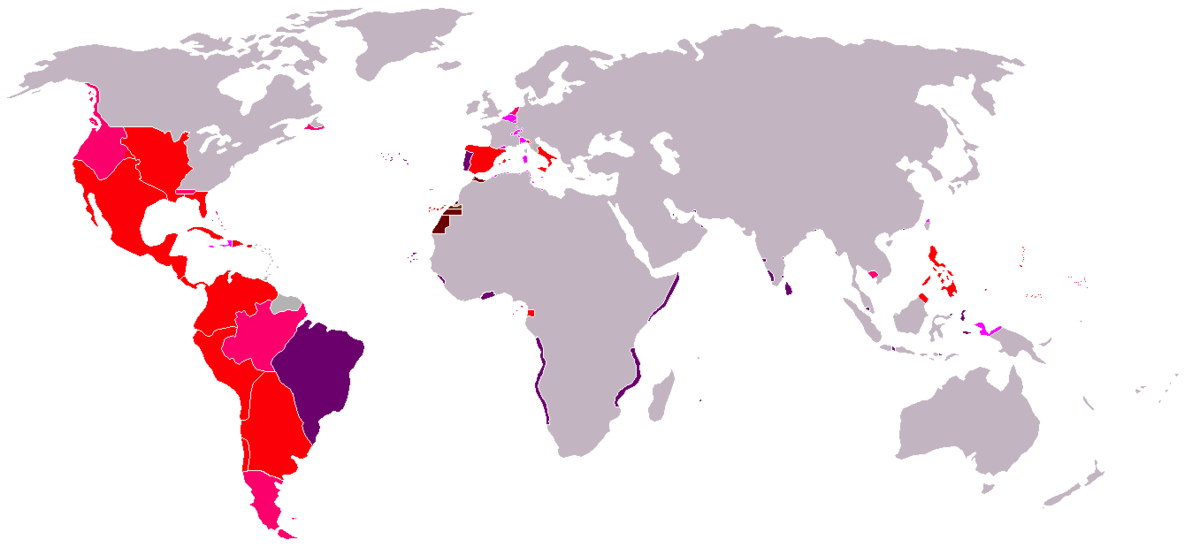
Carlos I , inherited the following terriories:
        • From Isabella I (his maternal grandmother):
            •  Castilla
            • Navarra
            • Territories in Americas
            • Cities in North Africa  
        • From Ferdinand II(his maternal grandfather):
            • Crown of Aragón
            • Italian territories 
              • Naples
              • Sicily
              • Sardinia
        • From Felipe I (his father)
            • Low countries 
            • Franche-Comté
        • From Maximilian I(His paternal grandfather)   
            • Austria
            • Holy Roman Empire     

Imagen relacionada                   


The Revolt of the Comuneros began in 1520 and finished in 1522.

There was great discontent in Castile for the future absence of the king to be proclaimed emperor. Carlos was seen as a foreign king who rewarded the Burgundians.
In this revolt the lower nobility and boutgeoisie in some cities rose up againist the goverment.

The king representatives and the high nobility supported Carlos V defeated the comuneros in the Battle of Villalar in 1521.
The most important leaders that participate in this battle were:
              • Juan Bravo
              • Juan de padilla
              • Francisco Maldonado
Between 1519 and 1523, in the Revolt of the Brotherhoods , the bourgeoisie and peasants rose up againist the nobility in Valencia and Mallorca.


jueves, 28 de febrero de 2019

BIOGRAPHY

Carlos I of Spain, was borned the 24 of february of 1500 in Ghent, Flanders.This is where he lived until he went to Castile in 1517,so he didn´t speak spanish.
His parents  were Juana I of Castile and Felipe I of Castile.

Resultado de imagen de carlos v foto

In 1520, a series of dynastic alliances and premature deaths turned a 20 year-old into the most powerful monarch in Europe.

Under his reign and that of his son and successor, Philip II, Spain became the first world power, arts and culture began its Golden Age and formed the largest colonial empire ever seen.

After so many wars and conflicts, Carlos entered into a phase of reflection: about himself, about life and his experiences and, moreover, about the state of Europe.
 Finally, on September 21 of  1558 he died of malaria after a month of agony and fevers, caused by the bite of a mosquito from the stagnant waters of one of the ponds.
The coffin of Carlos is in the Royal Crypt of the Monastery of El Escorial, known as the Pantheon of the Kings.


Resultado de imagen de foto de la tumba de carlos V